
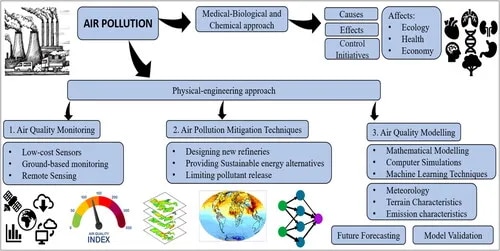
Evaluation of Pollution Monitoring
Description
Evaluation of Pollution Monitoring
Strengths and advancements in evaluation
• Real-time data: Modern sensor networks provide instant data, allowing for immediate responses to environmental changes, health alerts, and regulatory compliance.
• Technological diversity: The evaluation can incorporate a wide range of technologies, from established lab-based methods like gas chromatography-mass spectrometry to novel approaches like IoT sensors and satellite-based remote sensing.
• Improved accuracy: Miniaturized sensors and advanced communication technology are enhancing the accuracy and detail of measurements, especially for fine particulate matter.
• Comprehensive scope: Evaluation can include biological tools like biomarkers, which provide insights into the effects of pollution at a local level.
• Data-driven decision making: Monitoring provides the data needed to understand exposure levels, assess the health and economic impacts of pollution, and develop effective policies and interventions