Drinking Water Testing Lab in Rajasthan | NABL Accredited Lab | GECPL
Drinking Water Testing Lab in Rajasthan – Reliable Water Quality Analysis & Environmental Testing
Gurukripa Enviro Care Private Limited (GECPL) – NABL Accredited Lab
Safe and reliable water is essential for homes, industries, hospitals, hotels, institutions, commercial facilities, and public infrastructure. Water that looks clean may still contain microorganisms, dissolved salts, heavy metals, or other contaminants that cannot be detected without laboratory analysis.
For organizations searching for a Drinking Water Testing Lab in Rajasthan, selecting a technically competent laboratory with appropriate sampling and analytical capabilities is an important part of maintaining water-quality assurance.
Gurukripa Enviro Care Private Limited (GECPL) is a NABL Accredited Lab providing professional environmental testing, water testing, wastewater testing, sampling, monitoring, and consultancy services. With a practical approach to environmental analysis, GECPL supports industries and organizations in understanding water quality, evaluating treatment systems, and maintaining appropriate environmental records.
Why Drinking Water Testing is Important in Rajasthan
Rajasthan has diverse water sources and challenging climatic conditions. Drinking water may come from groundwater, borewells, municipal supplies, treated systems, storage tanks, or other sources. Water quality can therefore vary according to geology, source conditions, treatment efficiency, storage, distribution systems, and local activities.
Regular laboratory testing helps organizations move beyond assumptions about water quality and obtain measurable information about the water they actually use.
A good drinking-water monitoring program can help identify:
- Microbiological contamination
- Excessive dissolved solids
- Hardness and scaling-related issues
- Unwanted chemical constituents
- Heavy-metal contamination
- Changes in source-water quality
- Problems associated with treatment or storage
What is a Drinking Water Testing Laboratory?
A Drinking Water Testing Laboratory analyzes water samples using appropriate physical, chemical, microbiological, and other analytical methods.
Depending on the purpose of testing, a drinking-water program may assess parameters such as:
- pH
- Turbidity
- TDS
- Electrical conductivity
- Total hardness
- Alkalinity
- Chloride
- Sulphate
- Nitrate
- Fluoride
- Iron
- Selected heavy metals
- Total coliform
- E. coli and other applicable microbiological indicators
The exact test panel should be selected according to the source, intended use, risk profile, applicable standard, and testing objective.
Uses of Drinking Water Testing
Professional drinking-water testing has applications across residential, commercial, institutional, and industrial settings.
1. Drinking Water Quality Assessment
Testing helps organizations evaluate whether their water quality meets the applicable requirements for its intended use.
2. Borewell & Groundwater Testing
Groundwater can contain naturally occurring minerals and other constituents that vary from location to location. Laboratory testing provides objective data for assessment.
3. Water Treatment Verification
Testing can be used to evaluate water after treatment through systems such as RO, filtration, UV, or other purification processes.
4. Storage Tank Monitoring
Water quality can change during storage. Periodic testing can help identify issues related to contamination or inadequate maintenance.
5. Institutional Water Safety
Schools, hospitals, hotels, factories, offices, and residential communities can use testing as part of their water-quality monitoring programs.
6. Environmental Compliance & Documentation
Laboratory results can support applicable environmental monitoring, quality-assurance, and compliance documentation.
Significance of Drinking Water Testing
A professional water-testing program is significant because many important contaminants cannot be identified through appearance, taste, or smell alone.
Major Benefits
- Supports public-health protection
- Provides objective water-quality information
- Helps identify contamination
- Supports treatment-system evaluation
- Helps detect changes over time
- Assists quality-control programs
- Provides documented analytical evidence
- Supports informed environmental decisions
Regular testing is particularly useful when water quality is critical to employee welfare, institutional operations, hospitality services, manufacturing processes, or public use.
Purpose of Drinking Water Testing
The primary purpose of drinking-water analysis is to generate reliable data about the quality of water at a specific source or point of use.
At Gurukripa Enviro Care Private Limited (GECPL), water testing can support:
- Routine water-quality monitoring
- Investigation of suspected contamination
- Source-water assessment
- Treatment-performance evaluation
- Microbiological quality assessment
- Chemical-quality assessment
- Environmental documentation
- Quality-control programs
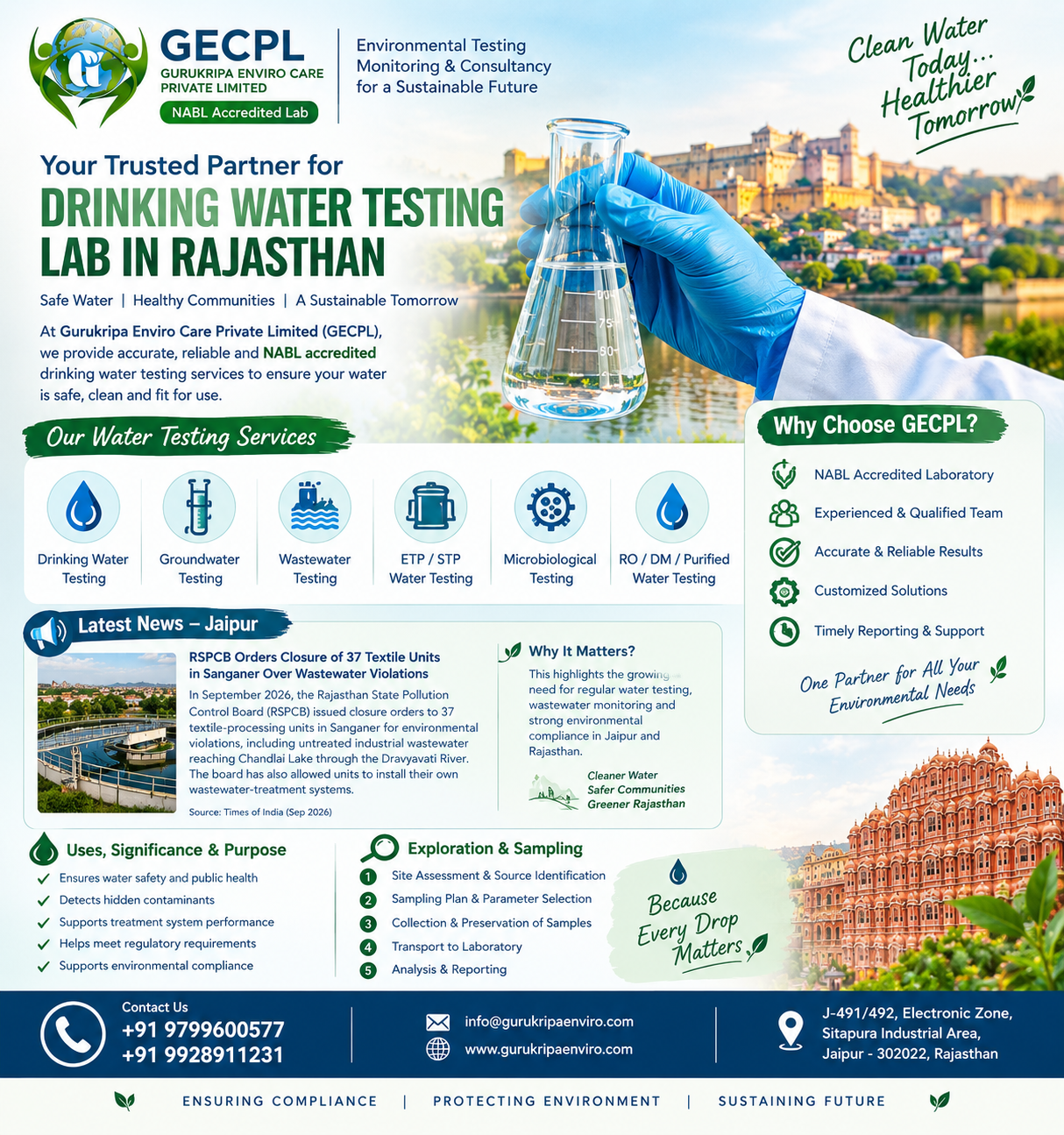
Exploration & Sampling – The Foundation of Accurate Results
Laboratory accuracy begins with proper field sampling.
Step 1: Source Exploration
Before sampling, the relevant water system may be reviewed, including:
- Water source
- Borewell or municipal supply
- Treatment system
- Storage arrangements
- Distribution network
- Intended use
- Previous test history
- Potential contamination sources
Step 2: Sampling Plan
A sampling plan can define:
- Monitoring locations
- Sampling frequency
- Test parameters
- Sample containers
- Preservation requirements
- Transportation conditions
Step 3: Representative Sample Collection
Depending on the project, samples may be collected from:
- Borewells
- Groundwater sources
- Municipal supply
- Storage tanks
- RO outlets
- Drinking-water taps
- Water coolers
- Institutional distribution points
Step 4: Preservation & Transportation
Appropriate handling, identification, preservation, and transportation help maintain sample integrity until laboratory analysis.
Step 5: Laboratory Testing
Samples are analyzed using appropriate analytical methods within the laboratory's relevant testing capabilities.
Step 6: Reporting
Results are compiled into a laboratory report for evaluation against the applicable standard, specification, or project requirement.
Drinking Water Testing Parameters
Physical Parameters
- Colour
- Odour
- Turbidity
- pH
- TDS
- Conductivity
Chemical Parameters
- Total hardness
- Alkalinity
- Chloride
- Sulphate
- Nitrate
- Fluoride
- Iron
- Calcium
- Magnesium
Heavy Metals & Trace Elements
Depending on the source and risk assessment:
- Lead
- Arsenic
- Cadmium
- Chromium
- Mercury
- Nickel
- Other relevant elements
Microbiological Parameters
Depending on the intended use:
- Total Coliform
- E. coli / thermotolerant coliform
- Other applicable microbiological parameters
Drinking Water Testing and Jaipur's Wastewater Challenge
Drinking-water quality cannot be considered separately from broader water management.
Jaipur has continued to face wastewater-management challenges, particularly around urban sewage and industrial wastewater. The situation around Sanganer has attracted regulatory attention because of concerns about industrial discharge and the protection of downstream water resources.
This makes water-quality testing, wastewater monitoring, treatment-system performance evaluation, and environmental compliance increasingly important for industries and institutions operating in and around Jaipur.
For a detailed and current news section, see the verified Jaipur updates following this article.
Water Testing for Industries
Industries often require multiple forms of water analysis, not just drinking-water testing.
GECPL can support requirements related to:
Drinking Water
For employee and institutional consumption.
Groundwater
For source-quality assessment.
Process Water
For industrial operations.
Wastewater
For treatment and environmental monitoring.
ETP/STP Water
For treatment-system performance evaluation.
RO / DM / Purified Water
For specialized industrial and laboratory applications.
Microbiological Water Testing
For microbiological quality evaluation.
Why Choose Gurukripa Enviro Care Private Limited (GECPL)?
NABL Accredited Lab
GECPL provides professional testing services supported by its NABL accreditation within the applicable scope.
Scientific Sampling
Reliable analytical results begin with representative sampling and appropriate sample handling.
Comprehensive Environmental Testing
In addition to water testing, GECPL supports environmental requirements relating to air, emissions, soil, waste, noise, and other environmental parameters.
Professional Reporting
Testing results are presented in a structured format to support quality management, compliance, and environmental decision-making.
Environmental Consultancy
GECPL provides technical support related to environmental testing, monitoring, and consultancy requirements.
Industries and Organizations We Serve
Our environmental and water-testing services can support:
- Manufacturing Industries
- Textile Industries
- Chemical Industries
- Pharmaceutical Industries
- Food & Beverage Units
- Power Plants
- Hotels & Resorts
- Hospitals
- Schools & Colleges
- Residential Societies
- Commercial Buildings
- Infrastructure Projects
- Water Treatment Facilities
Building a Strong Water Quality Monitoring Program
A useful long-term approach is:
SOURCE IDENTIFICATION → SAMPLING → LABORATORY ANALYSIS → DATA REVIEW → CORRECTIVE ACTION → RE-TESTING
Instead of relying only on one-time testing, organizations can maintain historical records and monitor changes in key parameters over time.
This can help identify recurring problems and support preventive action.
Frequently Asked Questions (FAQs)
1. What is a Drinking Water Testing Lab?
A drinking-water testing laboratory analyzes water samples for physical, chemical, microbiological, and other relevant quality parameters.
2. Why should drinking water be tested?
Testing can identify contaminants that may not be visible and provides objective information about water quality.
3. What water sources can be tested?
Depending on the service and testing requirements, samples may be collected from borewells, groundwater, municipal supplies, storage tanks, RO systems, taps, and other drinking-water sources.
4. What parameters are tested in drinking water?
Common parameters include pH, turbidity, TDS, hardness, chloride, sulphate, nitrate, fluoride, iron, selected heavy metals, and microbiological indicators.
5. How often should drinking water be tested?
Testing frequency should be based on the water source, intended use, risk profile, applicable requirements, and the organization's monitoring program.
6. Why is sampling important?
The laboratory can only analyze the sample received. Representative collection and correct preservation are therefore essential for meaningful results.
7. Does GECPL provide water sampling services?
GECPL provides professional environmental sampling and water-testing support according to project requirements and applicable testing scope.
8. Does GECPL test wastewater as well?
Yes. GECPL provides wastewater and environmental testing services in addition to drinking-water analysis.
9. Is GECPL located in Rajasthan?
Yes. GECPL is based in Jaipur, Rajasthan, and provides environmental testing and consultancy services for clients in Rajasthan and other locations.
Conclusion
For organizations looking for a Drinking Water Testing Lab in Rajasthan, quality testing should begin with a clear understanding of the water source, intended use, sampling requirements, applicable standards, and required analytical parameters.
Gurukripa Enviro Care Private Limited (GECPL), a NABL Accredited Lab, provides professional drinking-water testing, groundwater testing, wastewater testing, environmental monitoring, sampling, and consultancy services.
Our focus is to provide reliable analytical information that helps clients manage water quality, support environmental compliance, and make informed decisions.
Test Water. Understand Quality. Protect Every Drop.
Gurukripa Enviro Care Private Limited (GECPL)
NABL Accredited Lab
+91 9799600577 | +91 9928911231
J-491/492, Electronic Zone, Sitapura Industrial Area, Jaipur – 302022, Rajasthan
/drinking-water-testing-lab-in-rajasthan
- Drinking Water Testing Lab in Rajasthan
- Drinking Water Testing Laboratory Rajasthan
- Drinking Water Testing Lab Jaipur
- NABL Accredited Water Testing Lab Rajasthan
- NABL Accredited Laboratory Jaipur
- Drinking Water Quality Testing Rajasthan
- Drinking Water Analysis Jaipur
- Water Quality Testing Rajasthan
- Borewell Water Testing Rajasthan
- Groundwater Testing Rajasthan
- Microbiological Water Testing Rajasthan
- Wastewater Testing Rajasthan
- ETP Water Testing Rajasthan
- STP Water Testing Rajasthan
- Industrial Water Testing Rajasthan
- Water Sampling Services Rajasthan
- Water Testing Laboratory Jaipur
- Environmental Testing Lab Rajasthan
- GECPL Jaipur
- Gurukripa Enviro Care Private Limited
#DrinkingWaterTesting #WaterTesting #WaterTestingRajasthan #WaterTestingJaipur #NABLAccredited #NABLAccreditedLab #WaterQualityTesting #WaterQuality #GroundwaterTesting #BorewellWaterTesting #MicrobiologicalWaterTesting #WastewaterTesting #ETPTesting #STPTesting #WaterSampling #EnvironmentalTesting #EnvironmentalMonitoring #EnvironmentalCompliance #GECPL #GurukripaEnviroCare #Jaipur #Rajasthan #SafeWater #WaterManagement #CleanWater
Keywords