Happy Independence Day 2026: Building a Cleaner, Greener & Sustainable India
Gurukripa Enviro Care Private Limited (GECPL)
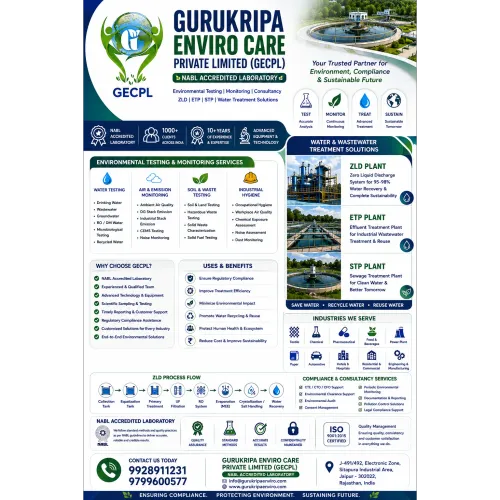
NABL Accredited Environmental Laboratory | Environmental Testing | ZLD | ETP | STP | Water Treatment & Consultancy
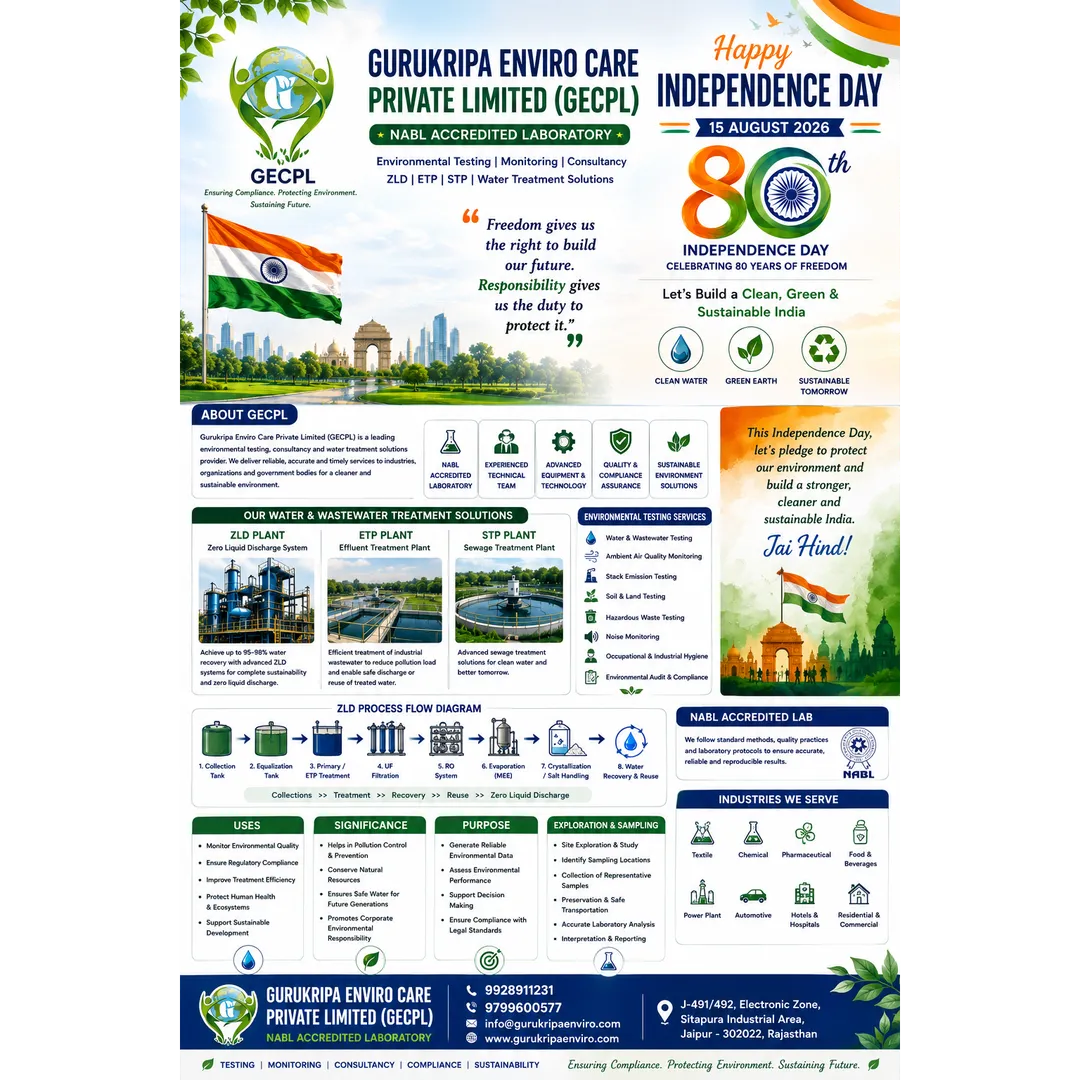
Happy 80th Independence Day – 15 August 2026
Independence Day is a celebration of India's freedom, unity, progress, and responsibility toward future generations. On 15 August 2026, India observes its 80th Independence Day, marking 79 years since independence in 1947.
At Gurukripa Enviro Care Private Limited (GECPL), we believe that a truly developed and independent India must also be a clean, healthy, water-secure, and environmentally responsible India.
This Independence Day, let us celebrate freedom by taking responsibility for the environment we share.
“Freedom gives us the right to build our future. Responsibility gives us the duty to protect it.”
Our Independence Day Message
Clean Environment. Clean Water. Sustainable India.
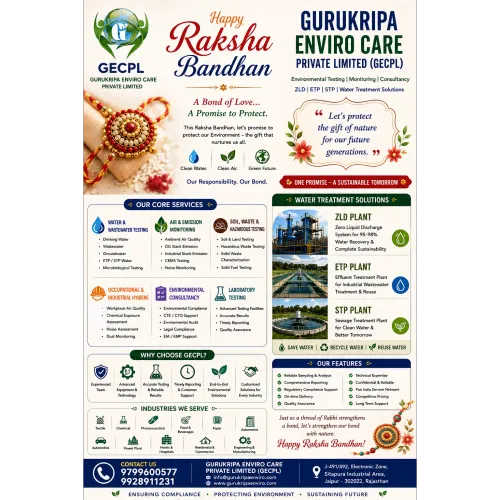
From environmental testing and monitoring to wastewater treatment and compliance support, GECPL works toward helping industries and organizations manage their environmental responsibilities scientifically and responsibly.
Our key areas include:
- Environmental Testing & Monitoring
- Water & Wastewater Testing
- Ambient Air Quality Monitoring
- Stack Emission Testing
- Soil & Land Testing
- Hazardous Waste Testing
- Occupational & Industrial Hygiene
- Environmental Compliance & Consultancy
- Zero Liquid Discharge (ZLD) Systems
- Effluent Treatment Plants (ETP)
- Sewage Treatment Plants (STP)
- Water Treatment, Recycling & Reuse Solutions
Why Environmental Protection Matters for a Strong India
India's growth depends on healthy natural resources. Clean air, safe water, productive land and responsible waste management are essential for sustainable economic and industrial development.
Environmental testing helps convert environmental conditions into measurable data. That data can then support better decisions about pollution control, treatment systems, compliance and resource management.
For example, drinking-water quality is addressed through Indian standards such as IS 10500, which specifies requirements and methods for sampling and testing drinking water.
Our Environmental Testing Services
1. Water & Wastewater Testing
We support water-quality assessment through laboratory testing and sampling of relevant water and wastewater parameters.
Applications
- Drinking water quality assessment
- Industrial wastewater analysis
- ETP outlet monitoring
- STP outlet monitoring
- Groundwater assessment
- Water-treatment performance evaluation
- Recycling and reuse programs
Significance
Water testing can help identify physical, chemical and microbiological characteristics that may require monitoring or corrective action.
2. Ambient Air Testing & Monitoring
Ambient air monitoring provides information about air quality at selected locations.
Applications
- Industrial areas
- Commercial areas
- Construction sites
- Residential surroundings
- Environmental monitoring programs
Purpose
To generate representative air-quality data that can support pollution-control decisions and environmental monitoring.
3. DG & Industrial Stack Emission Testing
Stack emission monitoring evaluates emissions released through industrial and DG-set stacks.
Parameters may include, as applicable:
- Particulate Matter
- Gaseous pollutants
- Stack temperature
- Stack velocity
- Flow-related parameters
Testing parameters should be selected according to the applicable regulatory requirements, source characteristics and monitoring objective.
4. Soil & Land Testing
Soil testing helps assess physical and chemical characteristics of soil.
Uses
- Industrial site assessment
- Environmental monitoring
- Land-quality evaluation
- Baseline environmental studies
- Investigation of potential contamination
5. Hazardous & Solid Waste Testing
Waste characterization can provide important information for appropriate handling, storage, treatment and disposal decisions.
Purpose
- Waste characterization
- Environmental risk assessment
- Treatment planning
- Compliance support
- Safer waste management
ZLD – Zero Liquid Discharge
Water Conservation Through Recovery & Reuse
A Zero Liquid Discharge (ZLD) system is an advanced wastewater-management approach designed to maximize water recovery and minimize or eliminate liquid wastewater discharge from the treatment system.
A typical ZLD configuration may incorporate several treatment stages depending on wastewater characteristics and project requirements.
Typical Process
Wastewater Collection
↓
Equalization
↓
Primary / Physico-Chemical Treatment
↓
Biological Treatment, Where Required
↓
Filtration / UF
↓
RO System
↓
Evaporation / MEE, Where Required
↓
Crystallization / Salt Handling, Where Required
↓
Water Recovery & Reuse
The actual configuration, recovery rate and equipment selection should be determined through wastewater characterization, pilot studies where appropriate, engineering design and site-specific requirements.
ETP – Effluent Treatment Plant
An Effluent Treatment Plant (ETP) is designed to treat industrial wastewater generated from manufacturing and other industrial activities.
Typical ETP Components
- Collection system
- Screening
- Equalization tank
- pH correction
- Chemical dosing
- Coagulation & flocculation
- Primary clarification
- Biological treatment, where required
- Secondary clarification
- Filtration
- Disinfection
- Sludge management
ETP Uses
✔ Pollution-load reduction
✔ Wastewater treatment
✔ Water reuse
✔ Environmental management
✔ Compliance support
STP – Sewage Treatment Plant
A Sewage Treatment Plant (STP) treats domestic sewage generated from residential, commercial and institutional facilities.
Typical STP Treatment Stages
Inlet → Screening → Equalization → Biological Treatment → Clarification → Filtration → Disinfection → Treated Water Reuse/Disposal
Treated water may be considered for suitable applications such as landscaping, flushing or other permitted reuse applications, subject to quality requirements and applicable permissions.
Exploration & Sampling – The Foundation of Reliable Environmental Data
A reliable environmental program begins with proper exploration and sampling.
Step 1: Site Exploration
The site may be evaluated for:
- Water sources
- Wastewater generation points
- Industrial processes
- Emission sources
- Existing treatment systems
- Potential contamination sources
- Sampling locations
- Existing environmental data
Step 2: Sampling Plan
A sampling plan should consider:
- Objective of testing
- Source characteristics
- Applicable standards
- Sampling frequency
- Required parameters
- Preservation requirements
- Transportation conditions
Step 3: Representative Sampling
Samples should be collected using appropriate procedures and suitable containers.
Step 4: Preservation & Transportation
Samples should be preserved and transported according to the requirements of the applicable test method.
Step 5: Laboratory Analysis
Samples are analyzed using appropriate laboratory methods within the relevant testing capability.
Step 6: Interpretation
Results can then be evaluated against the applicable standards, consent conditions, project requirements or other relevant criteria.
Purpose of Environmental Testing
Environmental testing is not simply about obtaining a report. Its broader purpose is to provide reliable information that can support:
- Pollution prevention
- Environmental compliance
- Water conservation
- Treatment optimization
- Waste management
- Workplace safety
- Environmental planning
- Sustainable industrial development
Our Vision for a Sustainable India
This Independence Day, GECPL promotes a simple message:
# INDEPENDENT INDIA
# CLEAN INDIA
# WATER-SECURE INDIA
# SUSTAINABLE INDIA
Environmental responsibility should be part of India's growth story—not an afterthought.
From testing and monitoring to ZLD, ETP, STP and water-treatment solutions, responsible environmental management can help industries move toward more efficient use of resources and better environmental performance.
Frequently Asked Questions
1. What does GECPL provide?
Gurukripa Enviro Care Private Limited (GECPL) provides environmental testing, monitoring, sampling, consultancy and wastewater-management related services.
2. What is ZLD?
Zero Liquid Discharge is a wastewater-management approach focused on recovering and reusing water while minimizing or eliminating liquid discharge from the treatment process.
3. What is an ETP?
An Effluent Treatment Plant treats wastewater generated by industrial processes.
4. What is an STP?
A Sewage Treatment Plant treats domestic sewage from residential, commercial and institutional sources.
5. Why is environmental sampling important?
Representative sampling is essential because laboratory results are meaningful only when the collected sample properly represents the environmental source being investigated.
6. What environmental parameters can be tested?
Depending on the project, testing may cover water, wastewater, air, emissions, soil, waste, noise and other environmental parameters.
7. Can treated wastewater be reused?
Treated wastewater may be suitable for certain reuse applications when its quality meets the requirements applicable to that particular use.
8. Why should industries monitor their environmental performance?
Regular monitoring can help identify changes, evaluate treatment performance, maintain records and support environmental compliance and pollution-prevention efforts.
Happy Independence Day from GECPL
On this 15 August 2026, let us remember that the freedom we celebrate today comes with a responsibility to protect the country we leave behind tomorrow.
Let us work for an India where development and environmental protection move together.
Vande Mataram
Gurukripa Enviro Care Private Limited (GECPL)
Environmental Testing | Monitoring | Consultancy | ZLD | ETP | STP | Water Treatment
“Ensuring Compliance. Protecting Environment. Sustaining Future.”
Company Contact:
Gurukripa Enviro Care Private Limited (GECPL)
📞 +91 9928911231 / +91 9799600577
📍 J-491/492, Electronic Zone, Sitapura Industrial Area, Jaipur – 302022, Rajasthan
Keywords