

Drinking Water Testing Laboratory – Ensuring Safe, Reliable & Quality Drinking Water
Gurukripa Enviro Care Private Limited (GECPL) – NABL & MoEF&CC Accredited Lab
Access to safe drinking water is fundamental to public health, but water that looks clear is not necessarily free from harmful contaminants. Changes in groundwater quality, aging pipelines, industrial activities, agricultural runoff, storage tanks, and inadequate disinfection can all affect water quality.
A professional Drinking Water Testing Laboratory plays an important role in identifying physical, chemical, microbiological, and other contaminants that may affect the safety and usability of drinking water.
Gurukripa Enviro Care Private Limited (GECPL) is a NABL and MoEF&CC Accredited Lab providing professional environmental and water testing services. Our testing solutions help industries, institutions, residential communities, hotels, hospitals, commercial establishments, and other organizations evaluate drinking water quality and support environmental and public-health objectives.
What is Drinking Water Testing?
Drinking water testing is the scientific examination of a water sample to determine its quality and identify potential contaminants.
Depending on the source and purpose of testing, analysis may cover:
- Physical characteristics
- Chemical parameters
- Heavy metals
- Microbiological quality
- Inorganic contaminants
- Organic contaminants
- Disinfection-related parameters
- Other site-specific parameters
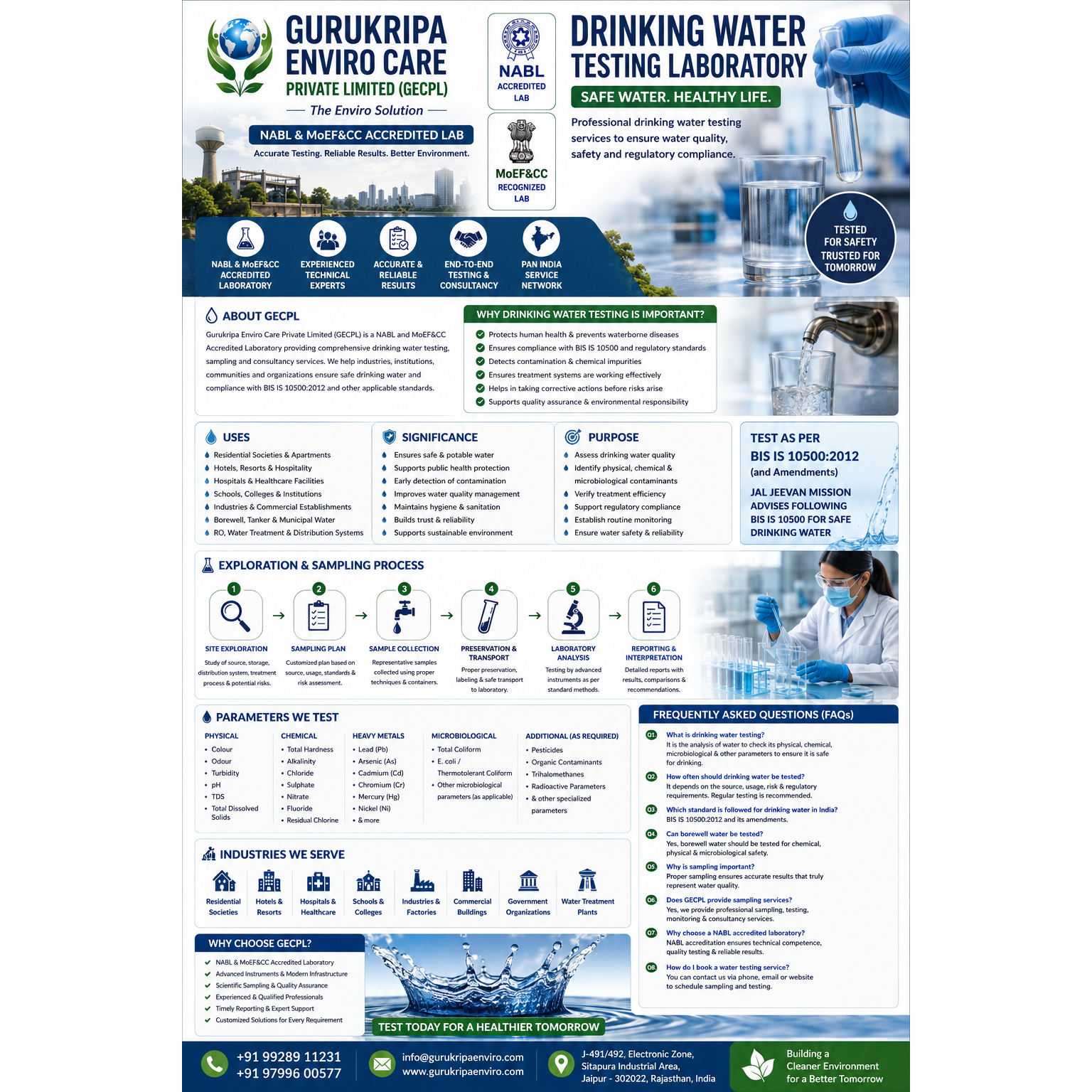
In India, BIS IS 10500 is an important reference standard for drinking-water quality. The Jal Jeevan Mission has advised states and UTs to follow BIS IS 10500:2012 and subsequent amendments for safe drinking water.
Why is Drinking Water Testing Important?
Water quality can vary significantly depending on its source and surroundings. A borewell, municipal supply, packaged water source, overhead tank, or treated water system may each require a different testing approach.
Regular testing can help organizations:
- Identify potential contamination
- Assess water quality trends
- Verify treatment effectiveness
- Support hygiene and sanitation programs
- Detect microbiological contamination
- Evaluate chemical characteristics
- Support regulatory and quality requirements
- Make informed decisions about treatment and corrective actions
A key point is that water testing should be based on the intended use, source, risk profile, and applicable requirements rather than relying on a single universal test panel.
Uses of Drinking Water Testing
1. Residential & Housing Communities
Testing can help housing societies and residential communities assess water supplied through municipal sources, borewells, tankers, or other sources.
2. Hotels & Hospitality
Hotels and resorts can use water testing to monitor water supplied to guests and staff and to support internal quality-management programs.
3. Hospitals & Healthcare Facilities
Water quality monitoring is particularly important in healthcare environments where water hygiene is an essential part of overall infection-control and facility-management practices.
4. Schools & Educational Institutions
Schools and colleges can periodically evaluate drinking water sources and storage systems.
5. Industries & Commercial Establishments
Businesses can test drinking water supplied to employees and visitors as part of workplace welfare and facility management.
6. Groundwater & Borewell Sources
Testing helps identify naturally occurring or human-influenced contaminants that may affect groundwater quality.
7. Water Treatment Systems
Testing can help evaluate the performance of filtration, disinfection, RO, or other water treatment systems.
Significance of Drinking Water Testing
The significance of drinking water testing goes beyond obtaining a laboratory report. It provides scientific information that can guide decisions about water safety, treatment, and management.
Public Health Protection
Microbiological and chemical testing can help identify potential hazards that may not be visible to the naked eye.
Early Detection
Regular monitoring can reveal changes in water quality before they become larger problems.
Treatment Verification
Testing can help evaluate whether a water treatment system is functioning effectively.
Quality Assurance
Organizations can establish documented water quality monitoring programs based on their specific requirements.
Environmental Management
Testing groundwater and other water sources can contribute to broader environmental monitoring programs.
Purpose of Drinking Water Testing
The main purpose of drinking water testing is to generate reliable analytical information about water quality.
At Gurukripa Enviro Care Private Limited (GECPL), testing can support organizations in:
- Evaluating drinking water quality
- Monitoring water sources
- Assessing treatment efficiency
- Investigating suspected contamination
- Supporting environmental compliance
- Establishing routine monitoring programs
- Identifying parameters requiring corrective action
- Maintaining documented water quality records
The appropriate test parameters should always be selected according to the water source, intended use, applicable standard, and specific risk assessment.
What Parameters Can Be Tested?
The exact test panel depends on the purpose and applicable requirements. Common categories include:
Physical Parameters
- Colour
- Odour
- Turbidity
- pH
- Total Dissolved Solids (TDS)
Chemical Parameters
- Total Hardness
- Alkalinity
- Chloride
- Sulphate
- Nitrate
- Fluoride
- Iron
- Residual Chlorine
Heavy Metals & Trace Elements
Depending on the source and risk profile, testing may include:
- Lead
- Arsenic
- Cadmium
- Chromium
- Mercury
- Nickel
- Other relevant elements
Microbiological Parameters
Testing may include:
- Total Coliform
- E. coli / Thermotolerant Coliform
- Other microbiological parameters as applicable
Additional Parameters
Depending on source and site conditions:
- Pesticides
- Organic contaminants
- Trihalomethanes
- Radioactive parameters
- Other specialized contaminants
The BIS framework includes a wide range of physical, chemical, microbiological, and other requirements. Therefore, a risk-based and purpose-specific testing plan is often more useful than selecting parameters without considering the water source.
Exploration & Sampling – The Most Important First Step
Reliable water testing begins before the sample reaches the laboratory.
1. Source Exploration
Before sampling, the environmental professional may review:
- Source of water
- Groundwater or surface-water conditions
- Municipal supply
- Borewell characteristics
- Water treatment process
- Storage tanks
- Distribution system
- Previous test results
- Potential contamination sources
This information helps determine the appropriate sampling locations and test parameters.
2. Sampling Plan
A sampling plan may be prepared based on:
- Testing objective
- Water source
- Intended use
- Applicable standard
- Site-specific risks
- Required testing frequency
For example, a sample collected directly from the source may provide different information from a sample collected at the final drinking-water tap.
3. Sample Collection
Representative samples are collected using appropriate containers and procedures.
Depending on the requirement, samples may be collected from:
- Borewells
- Municipal water supply
- Storage tanks
- Drinking-water taps
- Water treatment plants
- RO systems
- Packaged water facilities
- Institutional water systems
Microbiological samples require particularly careful collection, preservation, and handling to minimize contamination or changes before analysis.
4. Sample Preservation & Transportation
After collection, samples should be properly identified, preserved where required, and transported under appropriate conditions.
This is essential because improper handling can affect the reliability of analytical results.
BIS documentation includes specific sampling provisions for drinking-water testing, emphasizing the importance of following appropriate sampling requirements.
5. Laboratory Analysis
After receiving the sample, laboratory analysis is performed according to applicable test methods and the laboratory's relevant scope and capabilities.
Results are then compiled into a detailed laboratory report.
6. Interpretation & Corrective Action
Testing is most valuable when results are properly interpreted.
If a parameter shows an undesirable result, possible actions may include:
- Re-sampling for confirmation
- Investigating the source
- Cleaning storage tanks
- Reviewing treatment systems
- Improving disinfection
- Checking pipelines and distribution systems
- Implementing appropriate corrective measures
Any corrective action should be based on the actual contaminant, its concentration, the applicable requirement, and professional technical advice.
A New Approach: From 'One-Time Testing' to Water Quality Intelligence
A modern drinking-water testing program should not always be limited to a single laboratory report.
Organizations can develop a Water Quality Intelligence Program that combines:
Source Mapping → Risk Assessment → Sampling → Laboratory Testing → Trend Analysis → Corrective Action → Re-Testing
This approach can help identify recurring patterns, such as seasonal changes in groundwater quality, recurring microbiological contamination, or gradual changes in chemical parameters.
For organizations managing multiple water sources, maintaining historical test data can also help identify trends and prioritize preventive action.
This approach makes drinking water testing a continuous quality-management tool, rather than simply a compliance activity.
Why Choose Gurukripa Enviro Care Private Limited (GECPL)?
NABL & MoEF&CC Accredited Lab
GECPL provides environmental and water testing services backed by professional technical capabilities.
Scientific Sampling
Proper sampling is treated as an essential part of reliable testing.
Comprehensive Water Testing
Testing solutions can be designed for drinking water and other water-quality requirements based on the specific project.
Professional Reporting
Detailed analytical reports help organizations understand their water quality results.
Environmental Expertise
GECPL supports clients with water testing, environmental monitoring, and related consultancy requirements.
Customized Testing Approach
Testing parameters can be selected according to source, intended use, applicable requirements, and site-specific concerns.
Who Can Benefit from Drinking Water Testing?
Our services can be relevant for:
- Residential Societies
- Industries
- Hotels & Resorts
- Hospitals
- Schools & Colleges
- Offices
- Commercial Buildings
- Factories
- Institutions
- Government Organizations
- Water Treatment Facilities
- Construction & Infrastructure Projects
Frequently Asked Questions (FAQs)
1. What is a Drinking Water Testing Laboratory?
A drinking water testing laboratory analyzes water samples to determine physical, chemical, microbiological, and other relevant quality parameters.
2. Why should drinking water be tested?
Testing helps identify potential contamination, evaluate water quality, verify treatment performance, and support applicable quality or regulatory requirements.
3. How often should drinking water be tested?
The appropriate frequency depends on the source, intended use, risk profile, regulatory requirements, and the organization's monitoring program.
4. What is the BIS standard for drinking water in India?
IS 10500:2012 is the important BIS standard for drinking water specifications, along with applicable amendments. India's Jal Jeevan Mission has advised following IS 10500:2012 and subsequent amendments for prescribed drinking-water quality.
5. Can borewell water be tested for drinking purposes?
Yes. Borewell water can be tested to evaluate its suitability for the intended use. The appropriate parameters should be selected based on local geology, source conditions, and potential contamination risks.
6. What is the difference between drinking water testing and wastewater testing?
Drinking water testing focuses on assessing water quality for potable or intended human consumption purposes, whereas wastewater testing evaluates effluent characteristics and treatment performance before discharge or reuse.
7. Why is microbiological testing important?
Microbiological testing helps detect indicator organisms that can signal potential contamination and hygiene concerns.
8. Why is proper sampling important?
A laboratory can only analyze the sample it receives. If sampling is not representative or the sample is improperly handled, the test result may not accurately reflect the actual water quality.
9. Does GECPL provide water sampling and testing?
GECPL provides professional environmental testing and sampling services based on project requirements and applicable testing scope.
Conclusion
Choosing a reliable Drinking Water Testing Laboratory is an important step toward understanding and managing water quality. From physical and chemical parameters to microbiological analysis, scientific testing provides valuable information that can support public health, environmental management, and water quality assurance.
Gurukripa Enviro Care Private Limited (GECPL), a NABL and MoEF&CC Accredited Lab, provides professional water testing, sampling, environmental monitoring, and consultancy services designed around the specific needs of industries, institutions, and organizations.
With a focus on scientific sampling, reliable laboratory analysis, professional reporting, and environmental responsibility, GECPL supports its clients in building stronger water quality management systems and contributing to a safer, healthier, and more sustainable future.
Gurukripa Enviro Care Private Limited (GECPL) – The Enviro Solution
Test. Monitor. Understand. Protect.
SEO Meta Title
Drinking Water Testing Laboratory | NABL & MoEF&CC Accredited Lab | GECPL
SEO Meta Description
Looking for a reliable Drinking Water Testing Laboratory? Gurukripa Enviro Care Private Limited (GECPL), NABL & MoEF&CC Accredited Lab, provides drinking water sampling, chemical, physical and microbiological testing services.
Primary SEO Keywords
- Drinking water testing laboratory
- Drinking water testing laboratory in Jaipur
- Drinking water testing lab in Jaipur
- Drinking water testing services
- NABL accredited water testing laboratory
- NABL accredited drinking water testing lab
- Water quality testing laboratory
- Drinking water quality testing
- Drinking water analysis
- Drinking water sample testing
- Drinking water sampling services
- Microbiological water testing
- Chemical water testing
- Water quality analysis
- BIS IS 10500 water testing
- Drinking water testing as per IS 10500
- Borewell water testing
- Groundwater testing
- Water testing services in Rajasthan
- Water testing laboratory Rajasthan
- GECPL water testing
- Gurukripa Enviro Care water testing
Social Media Promotional Keywords
Drinking Water Testing | Water Quality Testing | NABL Accredited Water Testing | Drinking Water Analysis | Water Sample Testing | Microbiological Water Testing | Chemical Water Testing | BIS IS 10500 | Water Quality Monitoring | Borewell Water Testing | Groundwater Testing | Safe Drinking Water | Environmental Testing Laboratory | Water Testing Laboratory Jaipur | Water Testing Services Rajasthan
Recommended Hashtags
#DrinkingWaterTesting
#WaterQualityTesting
#DrinkingWaterLaboratory
#NABLAccreditedLab
#WaterTesting
#WaterQuality
#MicrobiologicalTesting
#ChemicalTesting
#WaterAnalysis
#WaterSampling
#IS10500
#BIS10500
#BorewellWaterTesting
#GroundwaterTesting
#EnvironmentalTesting
#EnvironmentalLaboratory
#NABLAccredited
#MoEFCC
#WaterQualityMonitoring
#SafeDrinkingWater
#EnvironmentalCompliance
#GECPL
#GurukripaEnviroCare
#Jaipur
#Rajasthan
#TheEnviroSolution
#SustainableFuture
Short LinkedIn Promotional Caption
💧 Is Your Drinking Water Really Safe?
Clear-looking water isn't necessarily contaminant-free. Gurukripa Enviro Care Private Limited (GECPL) – NABL & MoEF&CC Accredited Lab – provides professional Drinking Water Testing, Sampling & Water Quality Analysis to help industries, institutions, hotels, hospitals, residential communities and organizations better understand their water quality.
🔬 Physical | Chemical | Microbiological Testing
📊 Scientific Sampling & Reliable Analysis
🌿 Environmental Testing & Consultancy
Test your water. Understand your quality. Protect your people.
📞 +91 97996 00577
📧 info@gurukripaenviro.com
#DrinkingWaterTesting #WaterQualityTesting #NABLAccreditedLab #WaterTesting #GECPL #EnvironmentalTesting #Jaipur #Rajasthan #SafeDrinkingWater