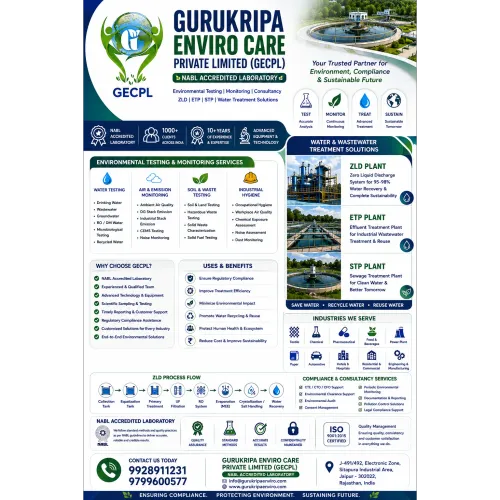


When it comes to building durable infrastructure, the ground beneath your project matters just as much as the structure itself. Geotechnical Investigation & Lab Testing plays a critical role in determining soil behavior, ensuring structural stability, and preventing costly failures. At Gurukripa Enviro Care Pvt Ltd (GECPL), we specialize in delivering precise and reliable geotechnical solutions tailored to diverse construction needs.
What is Geotechnical Investigation & Lab Testing?
Geotechnical investigation is the process of evaluating subsurface soil, rock, and groundwater conditions at a project site. It involves field exploration, sampling, and laboratory testing to determine engineering properties that influence design and construction.
Lab testing complements fieldwork by analyzing collected samples under controlled conditions to assess parameters such as strength, compressibility, permeability, and density.
Uses of Geotechnical Investigation
Geotechnical studies are indispensable across multiple sectors:
- Foundation Design: Determines the type and depth of foundations (shallow or deep).
- Construction Planning: Helps engineers anticipate challenges like soil settlement or slope instability.
- Infrastructure Projects: Essential for roads, bridges, dams, and railways.
- Environmental Assessments: Evaluates contamination risks and groundwater behavior.
- Slope Stability Analysis: Prevents landslides in hilly or unstable terrain.
Significance of Geotechnical Investigation
Ignoring subsurface conditions can lead to structural failures, safety hazards, and financial losses. Here’s why geotechnical investigation is crucial:
- Ensures Structural Safety: Identifies soil bearing capacity and load resistance.
- Cost Optimization: Prevents overdesign or unexpected construction delays.
- Risk Mitigation: Detects problematic soils like expansive clay or loose sand.
- Compliance: Meets regulatory and engineering standards.
At GECPL, our investigations are designed to reduce uncertainty and enhance project reliability.
Purpose of Geotechnical Investigation
The primary objectives include:
- Understanding soil stratification and composition
- Evaluating engineering properties of soil and rock
- Assessing groundwater conditions
- Providing design recommendations for foundations and earthworks
These insights enable engineers to design structures that are both safe and economical.
Exploration Methods in Geotechnical Investigation
Exploration is the first step in understanding subsurface conditions. Common methods include:
1. Borehole Drilling
Used to extract soil and rock samples from different depths.
2. Standard Penetration Test (SPT)
Measures soil resistance and provides data on density and strength.
3. Cone Penetration Test (CPT)
Offers continuous profiling of soil properties.
4. Geophysical Methods
Non-invasive techniques like seismic surveys to assess subsurface layers.
Sampling Techniques
Accurate sampling is critical for reliable lab results. Two main types are:
- Disturbed Samples: Used for classification tests (e.g., grain size analysis).
- Undisturbed Samples: Preserve natural soil structure for strength and compressibility tests.
Sampling methods include:
- Split Spoon Sampler
- Shelby Tube Sampler
- Core Cutter Method
Laboratory Testing in Geotechnical Engineering
Lab testing provides quantitative data for design and analysis. Key tests include:
- Atterberg Limits: Determines soil plasticity
- Grain Size Analysis: Classifies soil type
- Compaction Test: Identifies optimum moisture content
- Shear Strength Tests: Measures soil resistance under load
- Permeability Test: Assesses water flow through soil
At Gurukripa Enviro Care Pvt Ltd (GECPL), we use advanced equipment and standardized procedures to ensure accurate and dependable results.
Why Choose Gurukripa Enviro Care Pvt Ltd (GECPL)?
- Experienced geotechnical engineers and technicians
- State-of-the-art laboratory facilities
- Compliance with national and international standards
- Timely and cost-effective solutions
- Customized reports for every project
Frequently Asked Questions (FAQs)
1. Why is geotechnical investigation necessary before construction?
It helps determine soil suitability, ensuring the structure is safe and stable.
2. What is the difference between field testing and lab testing?
Field testing is conducted on-site, while lab testing analyzes collected samples under controlled conditions.
3. How deep should soil investigation be conducted?
Depth depends on the project type, load requirements, and soil conditions—typically until stable strata are reached.
4. What happens if geotechnical investigation is ignored?
It can lead to foundation failure, structural damage, and increased costs.
5. How long does a geotechnical investigation take?
Duration varies based on project size and complexity, but typically ranges from a few days to a couple of weeks.
Conclusion
Geotechnical Investigation & Lab Testing is the backbone of any successful construction project. From ensuring safety to optimizing costs, it provides the critical data engineers rely on. Partnering with Gurukripa Enviro Care Pvt Ltd (GECPL) ensures that your project starts on a solid foundation—literally and technically.
If you're planning a project and need reliable geotechnical services, GECPL is equipped to deliver precision, quality, and trust.