

Hazardous Water Sampling and Testing – Ensuring Safe Water & Environmental Compliance Water contamination from industrial discharge, chemical waste, and hazardous substances is a serious environmental concern. Hazardous water sampling and testing plays a crucial role in identifying pollutants, protecting public health, and ensuring regulatory compliance. At Gurukripa Enviro Care Private Limited (GECPL) – NABL Accredited Lab, we provide accurate, reliable, and scientifically validated hazardous water testing services to industries, institutions, and government bodies.
What is Hazardous Water Sampling and Testing? Hazardous water sampling and testing is the scientific process of collecting water samples from contaminated sources and analyzing them for toxic substances, heavy metals, chemicals, pathogens, and other harmful pollutants. This process helps determine whether water is safe for discharge, reuse, or consumption, and ensures compliance with environmental standards set by pollution control authorities.
Uses of Hazardous Water Sampling and Testing Hazardous water testing is essential in multiple sectors, including:
1. Industrial Compliance Industries generating effluents must test wastewater before discharge to meet Pollution Control Board norms.
2. Environmental Monitoring Regular testing helps monitor contamination levels in surface water, groundwater, lakes, and rivers.
3. Wastewater Treatment Plants (ETP/STP) Evaluation of treatment efficiency and removal of hazardous chemicals.
4. Landfill & Hazardous Waste Sites Testing leachate and surrounding groundwater to prevent environmental damage.
5. Construction & Infrastructure Projects Assessment of water quality before excavation and land development.
Significance of Hazardous Water Testing Hazardous water sampling and testing is not just a regulatory requirement — it is a responsibility toward society and the environment.
✔ Protection of Public Health Prevents exposure to toxic chemicals like lead, mercury, arsenic, and industrial solvents.
✔ Environmental Protection Reduces contamination of soil, groundwater, and aquatic ecosystems.
✔ Legal & Regulatory Compliance Avoids penalties, shutdown notices, and legal action due to non-compliance.
✔ Corporate Sustainability Enhances brand reputation and demonstrates commitment to environmental responsibility.
Purpose of Hazardous Water Sampling and Testing The primary objectives include: • Identifying hazardous substances in water • Determining pollutant concentration levels • Ensuring compliance with CPCB/SPCB guidelines • Supporting environmental impact assessments (EIA) • Preventing long-term ecological damage • Monitoring industrial discharge safety Exploration & Sampling Process Proper sampling is the foundation of accurate testing. At GECPL – NABL Accredited Lab, we follow standardized protocols to ensure reliable results.
Step 1: Site Assessment Our experts evaluate the contamination source and determine sampling points.
Step 2: Sample Collection Water samples are collected using sterilized containers as per regulatory guidelines.
Step 3: Preservation & Transportation Samples are preserved using appropriate chemicals and transported under controlled conditions.
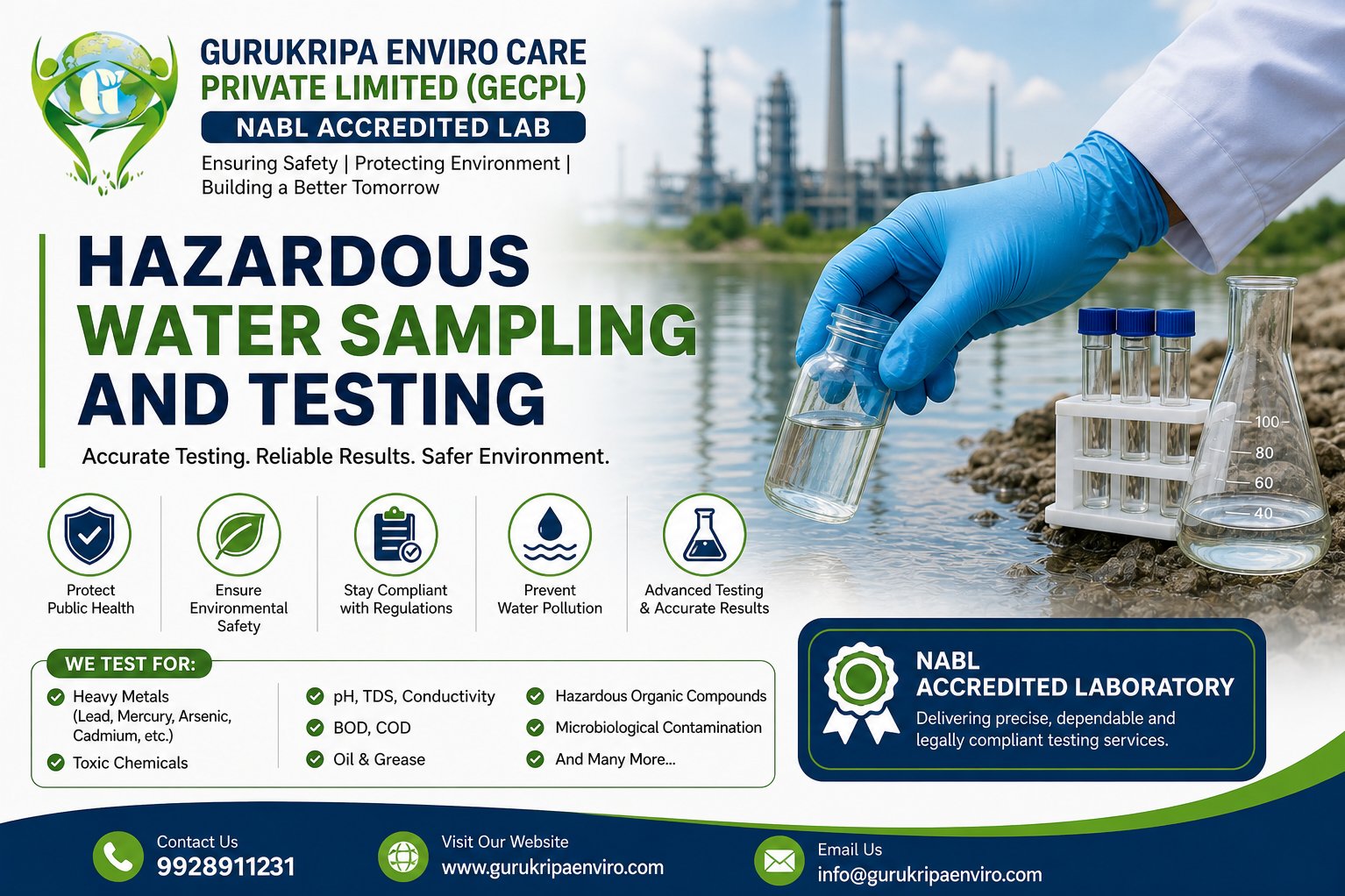
Step 4: Laboratory Analysis Advanced analytical instruments are used to test for: • Heavy metals • Toxic chemicals • pH & TDS • BOD & COD • Oil & grease • Hazardous organic compounds • Microbiological contamination
Step 5: Reporting We provide detailed analytical reports with interpretation and compliance status.
Why Choose Gurukripa Enviro Care Private Limited (GECPL)?
✔ NABL Accredited Laboratory
✔ Experienced Environmental Scientists
✔ Advanced Testing Equipment
✔ Timely & Accurate Reports
✔ Compliance with National & International Standards With years of expertise in environmental monitoring,
GECPL ensures dependable hazardous water sampling and testing services across industrial and commercial sectors.
Industries We Serve • Chemical Industries • Pharmaceutical Units • Textile & Dyeing Units • Mining & Metal Processing • Power Plants • Food Processing Units • Municipal Bodies
Frequently Asked Questions (FAQs)
1. What is hazardous water? Hazardous water contains harmful chemicals, heavy metals, toxic substances, or biological contaminants that pose risks to health and the environment.
2. How often should hazardous water be tested? Frequency depends on regulatory requirements and industrial operations. Many industries require monthly or quarterly testing.
3. Why is NABL accreditation important? NABL accreditation ensures that laboratory results are accurate, reliable, and legally acceptable.
4. What parameters are tested in hazardous water sampling? Common parameters include heavy metals, pH, TDS, BOD, COD, oil & grease, toxic organic compounds, and microbial contamination.
5. What happens if hazardous levels exceed limits? Corrective actions such as treatment upgrades, process modification, or discharge suspension may be required to meet compliance standards.
Conclusion Hazardous water sampling and testing is essential for safeguarding public health, maintaining environmental balance, and ensuring industrial compliance. Accurate sampling and scientific analysis are critical for reliable results. If your industry requires professional hazardous water testing services, trust Gurukripa Enviro Care Private Limited (GECPL) – NABL Accredited Lab for precision, compliance, and environmental responsibility.